Prompt Engineering vs Loop Engineering: The Surprising Difference Every AI User Should Know
Prompt Engineering vs Loop Engineering has become an increasingly important discussion as AI tools continue to evolve. Honestly, many people still believe writing a great prompt is enough. It isn't. Getting consistently high-quality AI output now depends on more than a single instruction.
That's where Loop Engineering enters the picture.
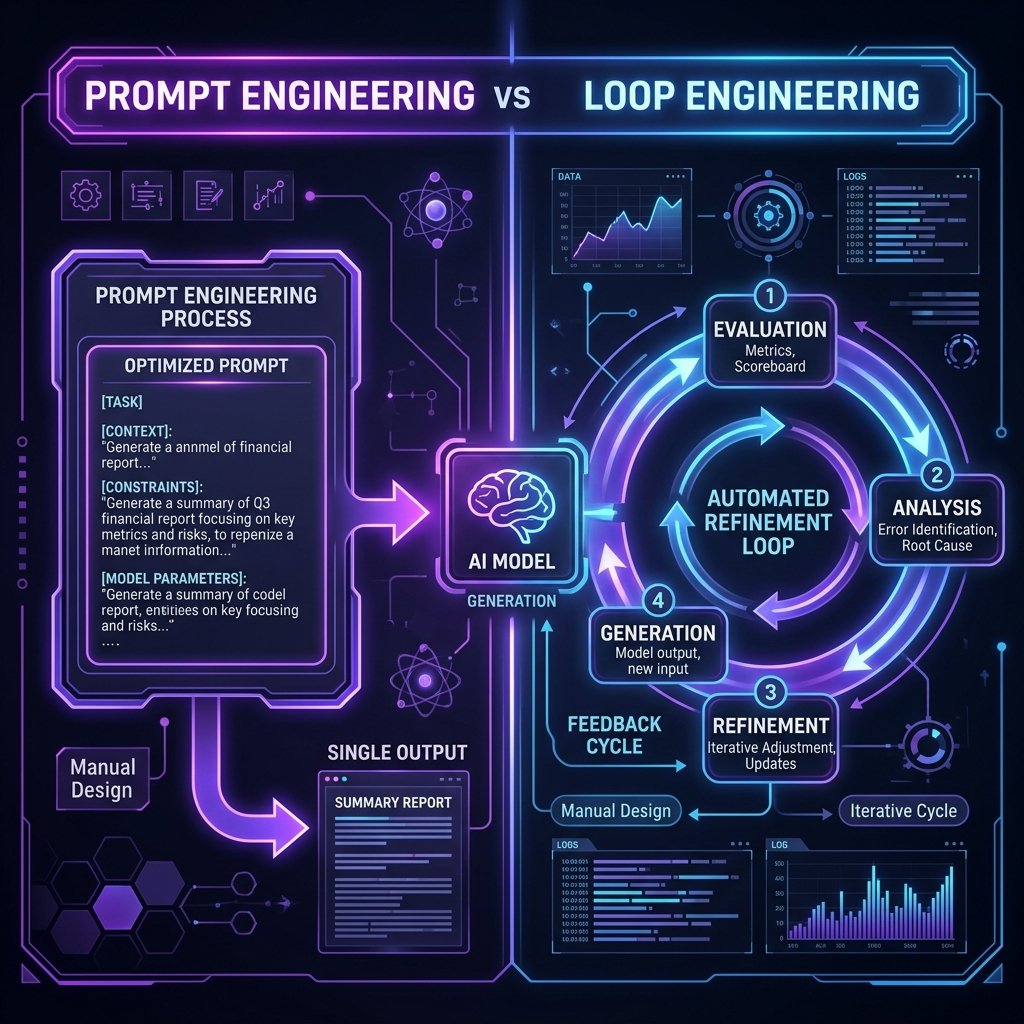
While Prompt Engineering focuses on crafting better instructions, Loop Engineering focuses on creating systems that continuously refine, evaluate, and improve AI interactions.
Let's break it down.
What is Prompt Engineering?
Prompt Engineering is the process of writing instructions that help AI produce accurate, relevant, and useful responses.
A well-written prompt provides the AI with:
- Context
- Objective
- Constraints
- Expected output
- Tone
- Audience
- Examples
Instead of asking:
"Write a blog."
You might ask:
"Write a 1,000-word SEO blog targeting beginners with a conversational tone, optimized for Google Search, including FAQs and actionable examples."
The second prompt gives the AI far more information, resulting in significantly better output.
Why Prompt Engineering Matters
AI models are only as effective as the instructions they receive.
Good prompts help reduce:
- Hallucinations
- Missing information
- Generic responses
- Incorrect formatting
- Multiple revisions
That saves time while producing higher-quality results.
No wonder Prompt Engineering has become one of the most valuable AI skills.
What is Loop Engineering?
Loop Engineering goes one step further.
Instead of asking AI only once, it creates an automated improvement cycle.
The workflow usually looks like this:
- Generate an initial response.
- Analyze quality.
- Detect weaknesses.
- Improve the prompt.
- Generate a better response.
- Repeat until quality reaches the desired level. </
Rather than depending on one prompt, the system learns from previous iterations.
Think of it as giving AI a feedback loop instead of a single instruction.
Why Loop Engineering Is Growing
Modern AI products are becoming more autonomous.
Instead of expecting users to manually rewrite prompts, platforms are starting to improve prompts automatically.
Some systems evaluate:
- Clarity
- Missing context
- Output structure
- Task completion
- Formatting
- Specificity
Then they rewrite the prompt before sending it back to the AI.
The user simply receives a better result.
This makes AI easier for beginners while helping professionals work faster.
Prompt Engineering vs Loop Engineering
| Feature | Prompt Engineering | Loop Engineering |
|---|---|---|
| Goal | Create a strong prompt | Continuously improve results |
| User involvement | High | Lower after setup |
| Automation | Limited | Extensive |
| Feedback cycle | Usually one-time | Continuous |
| Best for | Individuals | AI products and workflows |
| Scalability | Moderate | High |
Prompt Engineering improves the instruction.
Loop Engineering improves the entire process.
Where PromptGPT.io Fits
PromptGPT.io combines both approaches to make AI more useful.
Instead of asking users to master prompt writing, PromptGPT transforms rough ideas into structured prompts that work better across leading AI models.
Key capabilities include:
- Prompt Optimization
- Prompt Expansion
- Prompt Improvement
- Prompt Scoring
- AI Model Optimization
- Prompt Templates
- Prompt History
- Chrome Extension
- Mobile App
One of its standout features is Dynamic Prompt Optimization.
Instead of improving only the text you type, PromptGPT can understand the context of your ongoing conversation and optimize the prompt accordingly.
That means the generated prompt is based on both your latest request and the surrounding discussion, making responses far more relevant.
This brings PromptGPT closer to Loop Engineering principles by using context to improve every interaction.
Real-World Examples
Content Marketing
Prompt Engineering: Create one optimized blog prompt.
Loop Engineering: Generate the blog, review readability, improve SEO, rewrite weak sections, and regenerate until quality targets are met.
Software Development
Prompt Engineering: Ask AI to generate an API.
Loop Engineering: Generate the API, run automated validation, detect missing endpoints, improve the prompt, and regenerate cleaner code.
Customer Support
Prompt Engineering: Write one customer response.
Loop Engineering: Evaluate sentiment, clarity, policy compliance, and customer satisfaction before sending the final response.
Research
Prompt Engineering: Summarize one article.
Loop Engineering: Generate the summary, compare sources, identify missing information, improve the prompt, and regenerate a more complete version.
Which One Should You Learn?
If you're new to AI, start with Prompt Engineering.
Learning how to communicate effectively with AI will improve every interaction.
Once you're comfortable, explore Loop Engineering.
It's especially valuable for developers, AI startups, automation engineers, and teams building AI-powered products.
The two approaches aren't competitors. They're complementary.
The Future of AI Workflows
The next generation of AI platforms won't rely solely on manual prompts.
They'll automatically:
- Analyze context
- Improve prompts
- Score outputs
- Detect errors
- Retry weak responses
- Learn from previous interactions
Users won't notice the improvement cycle. They'll simply receive better answers.
This shift is already happening across AI productivity tools.
Final Thoughts
Prompt Engineering remains the foundation of effective AI communication. Without clear instructions, even the best AI models struggle.
Loop Engineering builds on that foundation by introducing continuous feedback and automatic improvement.
Together, they create smarter, more reliable AI systems that require less manual effort.
If you want consistently better AI results, mastering Prompt Engineering is the first step. Using platforms like PromptGPT.io that introduce intelligent optimization workflows is the next logical step toward the future of AI productivity.
Frequently Asked Questions
1. What is Prompt Engineering?
Prompt Engineering is the practice of writing clear and structured instructions that help AI generate better responses.
2. What is Loop Engineering?
Loop Engineering is an iterative process where AI responses are evaluated and continuously improved through automated feedback loops.
3. Is Loop Engineering replacing Prompt Engineering?
No. Loop Engineering builds on Prompt Engineering rather than replacing it.
4. Which is better for beginners?
Prompt Engineering is easier to learn and provides immediate improvements in AI output quality.
5. Who benefits most from Loop Engineering?
Developers, AI startups, automation teams, and businesses creating AI-powered products benefit the most.
6. Can PromptGPT.io improve prompts automatically?
Yes. PromptGPT.io transforms rough ideas into professional prompts and includes Dynamic Prompt Optimization for more context-aware results.
7. Why is context important in AI prompting?
Context helps AI understand the user's goal, reducing misunderstandings and improving response accuracy.
8. Does Loop Engineering require coding?
Not always. Some AI platforms automate the process without requiring programming knowledge.
9. Can businesses use both approaches together?
Absolutely. Many organizations use Prompt Engineering for task creation and Loop Engineering for automated quality improvement.
10. What is the future of AI prompting?
Future AI systems will combine prompt optimization, context awareness, evaluation, and automatic refinement to deliver consistently better results with minimal user effort.